经典算法-回溯算法
刷题网站相关题目:
77. 组合 216. 组合总和 III
...
一、N皇后问题
N皇后问题是一个著名的组合问题,目标是在一个N×N的棋盘上放置N个皇后,使得它们互相不能攻击到对方(即不在同一行、同一列或同一对角线上)
1.1、问题描述
给定一个N×N的棋盘,要求放置N个皇后,使得它们互相不能攻击到对方。每个皇后可以水平、垂直或对角线移动。
1.2、解题思路
使用回溯算法解决N皇后问题。回溯算法是一种试错的算法,它尝试每一种可能性,如果达不到目标,则回溯到上一步,直到找到解决方案或尝试了所有可能性。
- 创建一个N×N的棋盘,初始化为0,其中0表示没有皇后,1表示有皇后。
- 从第一行开始,尝试在每一列放置皇后。对于每一列,检查是否可以放置皇后(即不会受到攻击)。如果可以,将该位置标记为1,并继续放置下一行的皇后。
- 如果在某一行无法找到一个合适的位置来放置皇后,回溯到上一行,将上一行的皇后移到下一个可行位置,并继续尝试。如果无法找到解决方案,回溯到更上一行,以此类推。
- 当放置了N个皇后且它们互相不受攻击时,找到一个解决方案。
- 继续尝试其他可能的放置方式,直到找到所有解决方案或尝试了所有可能性。
1.3、代码示例
#include <iostream>
#include <vector>

using namespace std;

// 检查是否可以在棋盘board[row][col]放置皇后
bool isSafe(vector<vector<int>>& board, int row, int col, int N) {
    // 检查列是否安全
    for (int i = 0; i < row; ++i) {
        if (board[i][col] == 1) {
            return false;
        }
    }

    // 检查左上对角线是否安全
    for (int i = row, j = col; i >= 0 && j >= 0; --i, --j) {
        if (board[i][j] == 1) {
            return false;
        }
    }

    // 检查右上对角线是否安全
    for (int i = row, j = col; i >= 0 && j < N; --i, ++j) {
        if (board[i][j] == 1) {
            return false;
        }
    }

    return true;
}

// 使用回溯算法解决N皇后问题
void solveNQueens(vector<vector<string>>& solutions, vector<vector<int>>& board, int row, int N) {
    if (row == N) {
        // 找到一个解决方案,将其存储为字符串表示
        vector<string> solution;
        for (int i = 0; i < N; ++i) {
            string rowStr(N, '.');
            for (int j = 0; j < N; ++j) {
                if (board[i][j] == 1) {
                    rowStr[j] = 'Q';
                }
            }
            solution.push_back(rowStr);
        }
        solutions.push_back(solution);
        return;
    }

    for (int col = 0; col < N; ++col) {
        if (isSafe(board, row, col, N)) {
            // 在当前位置放置皇后
            board[row][col] = 1;
            // 继续放置下一行的皇后
            solveNQueens(solutions, board, row + 1, N);
            // 回溯,移除当前位置的皇后
            board[row][col] = 0;
        }
    }
}

// 解决N皇后问题的入口函数
vector<vector<string>> solveNQueens(int n) {
    vector<vector<string>> solutions;
    vector<vector<int>> board(n, vector<int>(n, 0));
    solveNQueens(solutions, board, 0, n);
    return solutions;
}

int main() {
    int N;
    cout << "Enter the value of N for N-Queens problem: ";
    cin >> N;

    vector<vector<string>> solutions = solveNQueens(N);

    if (solutions.empty()) {
        cout << "No solutions found for N=" << N << endl;
    } else {
        cout << "Solutions for N=" << N << ":" << endl;
        for (const auto& solution : solutions) {
            for (const string& row : solution) {
                cout << row << endl;
            }
            cout << endl;
        }
    }

    return 0;
}
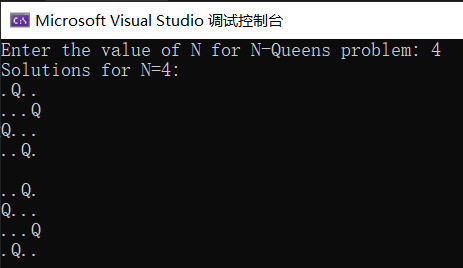
结果输出:
二、01背包问题
2.1、问题描述
有一个背包,它的容量是C。有n个物品,每个物品的重量是w[i],价值是v[i]。要求选择一些物品放入背包中,使得背包中物品的总重量不超过C,同时使得背包中物品的总价值最大。每个物品要么放入背包,要么不放入背包,不能将物品切割成小块。
2.2、解题思路
- 创建一个数组
selected,用于记录每个物品是否被选择放入背包。初始时,所有物品都未被选择。 - 从第一个物品开始,尝试将其放入背包。如果当前物品的重量不超过背包的容量,并且将其放入背包后,可以获得更多的总价值,就选择放入背包,并更新
selected数组。 - 递归尝试放入下一个物品,并继续判断是否满足背包容量限制和是否可以获得更多的总价值。
- 递归过程中,如果发现无法放入下一个物品或者已经尝试了所有物品,就回溯到上一步,将上一个物品移出背包。
- 重复上述步骤,直到遍历完所有物品或者无法继续放入物品为止。
- 在递归过程中,不断更新记录的最优解,以便找到总价值最大的放置方式。
2.3、代码示例
#include <iostream>
#include <vector>

using namespace std;

int maxTotalValue = 0; // 记录最大总价值
vector<int> selected; // 记录是否选择放入背包

// 使用回溯算法解决01背包问题
void solve01Knapsack(vector<int>& weights, vector<int>& values, int capacity, int currentWeight, int currentValue, int index) {
    if (index == weights.size() || currentWeight >= capacity) {
        // 递归结束条件:遍历完所有物品或背包已满
        if (currentValue > maxTotalValue) {
            maxTotalValue = currentValue;
            selected.assign(selected.begin(), selected.end()); // 更新最优解
        }
        return;
    }

    // 尝试放入当前物品
    if (currentWeight + weights[index] <= capacity) {
        selected[index] = 1;
        solve01Knapsack(weights, values, capacity, currentWeight + weights[index], currentValue + values[index], index + 1);
        selected[index] = 0; // 回溯,不放入当前物品
    }

    // 不放入当前物品
    solve01Knapsack(weights, values, capacity, currentWeight, currentValue, index + 1);
}

int main() {
    int n; // 物品数量
    cout << "Enter the number of items: ";
    cin >> n;

    vector<int> weights(n);
    vector<int> values(n);

    cout << "Enter the weights of items:" << endl;
    for (int i = 0; i < n; ++i) {
        cin >> weights[i];
    }

    cout << "Enter the values of items:" << endl;
    for (int i = 0; i < n; ++i) {
        cin >> values[i];
    }

    int capacity; // 背包容量
    cout << "Enter the capacity of knapsack: ";
    cin >> capacity;

    selected.resize(n, 0); // 初始化selected数组

    solve01Knapsack(weights, values, capacity, 0, 0, 0);

    cout << "Maximum total value: " << maxTotalValue << endl;
    cout << "Selected items: ";
    for (int i = 0; i < n; ++i) {
        if (selected[i]) {
            cout << i << " ";
        }
    }
    cout << endl;

    return 0;
}
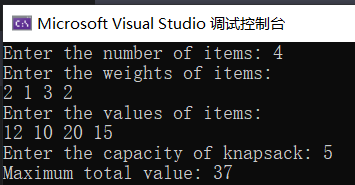
结果输出:
三、排列和组合问题
排列组合问题是指给定一组元素,求所有可能的排列或组合方式。
3.1、问题描述
给定一组不重复的整数,要求找出它们的所有排列。
3.2、解题思路
- 初始化一个空数组
result,用于存储所有排列的结果。 - 创建一个辅助函数
permuteHelper,该函数将一个当前排列current作为参数。初始时,current为空数组。 - 在
permuteHelper函数内,首先检查如果current的大小等于给定整数集合的大小,那么将current添加到result中,表示找到了一个排列。 - 否则,遍历整数集合中的每个元素,检查它是否已经在
current中。如果没有,将该元素添加到current,然后递归调用permuteHelper。 - 在递归返回后,将刚添加到
current的元素移除,以便尝试下一个元素。 - 最终,
result中将包含所有排列的结果。
3.3、代码示例
#include <iostream>
#include <vector>

using namespace std;

void permuteHelper(vector<int>& nums, vector<int>& current, vector<vector<int>>& result) {
    if (current.size() == nums.size()) {
        result.push_back(current);
        return;
    }

    for (int i = 0; i < nums.size(); ++i) {
        if (find(current.begin(), current.end(), nums[i]) == current.end()) {
            current.push_back(nums[i]);
            permuteHelper(nums, current, result);
            current.pop_back();
        }
    }
}

vector<vector<int>> permute(vector<int>& nums) {
    vector<vector<int>> result;
    vector<int> current;
    permuteHelper(nums, current, result);
    return result;
}

int main() {
    vector<int> nums = {1, 2, 3};
    vector<vector<int>> permutations = permute(nums);

    cout << "All permutations:" << endl;
    for (const vector<int>& perm : permutations) {
        for (int num : perm) {
            cout << num << " ";
        }
        cout << endl;
    }

    return 0;
}
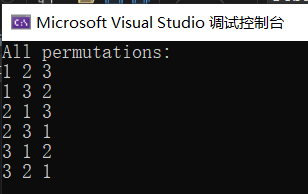
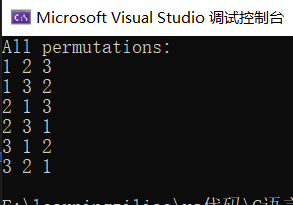
此代码将生成给定整数集合 {1, 2, 3} 的所有排列,并输出它们。
结果输出:
四、数独问题
数独问题是一个经典的求解填充数独游戏的问题,规则是在一个9x9的网格中,每行、每列和每个3x3的子网格中都必须包含数字1到9,而且不能重复。
4.1、问题描述
给定一个部分填充的9x9数独棋盘,其中已填入一些数字(用数字0-9表示,0表示空格)。任务是找到一种填充方式,满足数独游戏的规则。
4.2、解题思路
- 创建一个9x9的二维数组,表示数独棋盘。
- 创建一个辅助函数
solveSudoku,该函数使用回溯算法来填充数独。 - 在
solveSudoku函数内,首先遍历数独棋盘,寻找一个未填充数字的位置(值为0的位置)。 - 如果找到未填充数字的位置,尝试在该位置填入数字1到9,然后递归调用
solveSudoku继续填充下一个位置。 - 在递归返回后,如果数独已经成功填充完毕,返回
true表示成功。 - 如果在某一步填充数字时遇到冲突(即在同一行、同一列或同一个3x3子网格中已经存在相同的数字),则返回
false表示填充失败,需要回溯到上一步重新尝试。 - 最终,如果
solveSudoku函数返回true,表示成功填充了数独,否则表示无解。
4.3、代码示例
#include <iostream>
#include <vector>

using namespace std;

const int N = 9;

bool isValid(vector<vector<char>>& board, int row, int col, char num) {
    for (int i = 0; i < N; ++i) {
        if (board[row][i] == num || board[i][col] == num || board[3 * (row / 3) + i / 3][3 * (col / 3) + i % 3] == num) {
            return false;
        }
    }
    return true;
}

bool solveSudoku(vector<vector<char>>& board) {
    for (int row = 0; row < N; ++row) {
        for (int col = 0; col < N; ++col) {
            if (board[row][col] == '.') {
                for (char num = '1'; num <= '9'; ++num) {
                    if (isValid(board, row, col, num)) {
                        board[row][col] = num;
                        if (solveSudoku(board)) {
                            return true;
                        }
                        board[row][col] = '.'; // Backtrack
                    }
                }
                return false; // No valid solution found
            }
        }
    }
    return true; // All cells filled
}

int main() {
    vector<vector<char>> board = {
        {'5', '3', '.', '.', '7', '.', '.', '.', '.'},
        {'6', '.', '.', '1', '9', '5', '.', '.', '.'},
        {'.', '9', '8', '.', '.', '.', '.', '6', '.'},
        {'8', '.', '.', '.', '6', '.', '.', '.', '3'},
        {'4', '.', '.', '8', '.', '3', '.', '.', '1'},
        {'7', '.', '.', '.', '2', '.', '.', '.', '6'},
        {'.', '6', '.', '.', '.', '.', '2', '8', '.'},
        {'.', '.', '.', '4', '1', '9', '.', '.', '5'},
        {'.', '.', '.', '.', '8', '.', '.', '7', '9'}
    };

    if (solveSudoku(board)) {
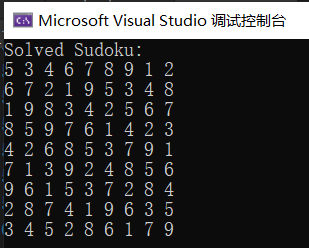
        cout << "Solved Sudoku:" << endl;
        for (int i = 0; i < N; ++i) {
            for (int j = 0; j < N; ++j) {
                cout << board[i][j] << " ";
            }
            cout << endl;
        }
    } else {
        cout << "No solution exists." << endl;
    }

    return 0;
}
结果输出:
五、全排列问题
5.1、问题描述
全排列问题是一个经典的组合学问题,要求给定一个包含不同元素的集合,找出这些元素的所有可能的排列方式。
5.2、解题思路
- 创建一个空的结果集,用于存储所有的排列。
- 创建一个辅助函数(例如
permute),该函数采用以下参数:- 当前正在生成的排列(初始为空)
- 剩余可用的元素列表
- 结果集
- 在
permute函数内,首先检查是否已经生成了一个完整的排列,如果是,则将其添加到结果集中。 - 否则,遍历剩余可用的元素,依次将每个元素添加到当前排列中,并从剩余元素列表中移除。然后递归调用
permute函数生成下一个排列。 - 在递归返回后,需要将添加的元素从当前排列中移除,并将其重新添加到剩余元素列表中,以便生成其他排列。
- 最终,
permute函数将生成所有可能的排列。
5.3、代码示例
#include <iostream>
#include <vector>

using namespace std;

void permute(vector<int>& nums, vector<vector<int>>& result, vector<int>& current) {
    if (current.size() == nums.size()) {
        result.push_back(current); // 找到一个完整的排列,添加到结果集
        return;
    }

    for (int i = 0; i < nums.size(); ++i) {
        if (find(current.begin(), current.end(), nums[i]) == current.end()) {
            current.push_back(nums[i]); // 添加元素到当前排列
            permute(nums, result, current); // 递归生成下一个排列
            current.pop_back(); // 回溯,移除最后一个元素
        }
    }
}

vector<vector<int>> permute(vector<int>& nums) {
    vector<vector<int>> result;
    vector<int> current;
    permute(nums, result, current);
    return result;
}

int main() {
    vector<int> nums = {1, 2, 3};
    vector<vector<int>> result = permute(nums);

    cout << "All permutations:" << endl;
    for (const vector<int>& perm : result) {
        for (int num : perm) {
            cout << num << " ";
        }
        cout << endl;
    }

    return 0;
}
结果输出:
六、子集合问题
6.1、问题描述
子集合问题是一个经典的组合学问题,给定一个集合,要求找出这个集合的所有可能的子集合。
6.2、解题思路
- 创建一个空的结果集,用于存储所有的子集合。
- 创建一个辅助函数(例如
subsets),该函数采用以下参数:- 当前正在生成的子集合(初始为空)
- 剩余可用的元素列表
- 结果集
- 在
subsets函数内,首先将当前子集合添加到结果集中。 - 遍历剩余可用的元素,依次将每个元素添加到当前子集合中,并从剩余元素列表中移除。然后递归调用
subsets函数生成下一个子集合。 - 在递归返回后,需要将添加的元素从当前子集合中移除,并将其重新添加到剩余元素列表中,以便生成其他子集合。
- 最终,
subsets函数将生成所有可能的子集合。
6.3、代码示例
#include <iostream>
#include <vector>

using namespace std;

void subsets(vector<int>& nums, vector<vector<int>>& result, vector<int>& current, int index) {
    result.push_back(current); // 添加当前子集合到结果集

    for (int i = index; i < nums.size(); ++i) {
        current.push_back(nums[i]); // 添加元素到当前子集合
        subsets(nums, result, current, i + 1); // 递归生成下一个子集合
        current.pop_back(); // 回溯,移除最后一个元素
    }
}

vector<vector<int>> subsets(vector<int>& nums) {
    vector<vector<int>> result;
    vector<int> current;
    subsets(nums, result, current, 0);
    return result;
}

int main() {
    vector<int> nums = {1, 2, 3};
    vector<vector<int>> result = subsets(nums);

    cout << "All subsets:" << endl;
    for (const vector<int>& subset : result) {
        for (int num : subset) {
            cout << num << " ";
        }
        cout << endl;
    }

    return 0;
}
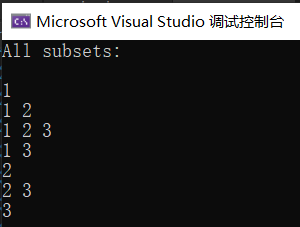
结果输出:
七、图的着色问题
7.1、问题描述
图的着色问题是指给定一个无向图,找到一种方法为图中的每个节点分配一种颜色,使得相邻的节点具有不同的颜色。这个问题的目标是使用尽量少的颜色来完成着色。
7.2、解题思路
- 创建一个数组(或向量)
colors,用于存储每个节点的颜色。初始时,所有节点都未被着色,可以使用一个特殊的值(如-1)表示未着色。 - 创建一个函数(例如
colorGraph),该函数采用以下参数:- 当前节点的索引
- 图的邻接表
- 颜色数组
- 在
colorGraph函数内,首先检查是否所有节点都已着色。如果是,表示已找到一种着色方案,可以将颜色数组添加到结果集中。 - 否则,遍历当前节点可用的颜色(通常从1到K,K表示允许的颜色数),并检查是否可以为当前节点着色。如果可以,将颜色赋给当前节点,然后递归调用
colorGraph函数处理下一个节点。 - 在递归返回后,需要撤销对当前节点的颜色分配,以便尝试其他颜色。这个过程称为回溯。
- 最终,
colorGraph函数将生成所有可能的着色方案。
7.3、代码示例
#include <iostream>
#include <vector>

using namespace std;

// 检查节点是否可以着色
bool isSafe(int node, int color, const vector<vector<int>>& graph, const vector<int>& colors) {
    for (int neighbor : graph[node]) {
        if (colors[neighbor] == color) {
            return false;
        }
    }
    return true;
}

void colorGraph(int node, const vector<vector<int>>& graph, vector<int>& colors, int numColors, vector<vector<int>>& result) {
    int numNodes = graph.size();

    // 如果所有节点都已着色,将当前着色方案添加到结果
    if (node == numNodes) {
        result.push_back(colors);
        return;
    }

    // 尝试为当前节点分配颜色
    for (int color = 1; color <= numColors; ++color) {
        if (isSafe(node, color, graph, colors)) {
            colors[node] = color;
            colorGraph(node + 1, graph, colors, numColors, result);
            colors[node] = -1; // 回溯,撤销颜色分配
        }
    }
}

vector<vector<int>> graphColoring(const vector<vector<int>>& graph, int numColors) {
    int numNodes = graph.size();
    vector<int> colors(numNodes, -1); // 初始化颜色数组
    vector<vector<int>> result;

    colorGraph(0, graph, colors, numColors, result);

    return result;
}

int main() {
    vector<vector<int>> graph = {
        {0, 1, 1, 0},
        {1, 0, 1, 1},
        {1, 1, 0, 1},
        {0, 1, 1, 0}
    };

    int numColors = 3; // 假设有3种颜色

    vector<vector<int>> colorSchemes = graphColoring(graph, numColors);

    cout << "Possible colorings:" << endl;
    for (const vector<int>& colors : colorSchemes) {
        for (int color : colors) {
            cout << color << " ";
        }
        cout << endl;
    }

    return 0;
}
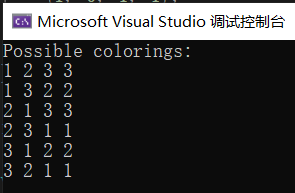
结果输出:
八、迷宫问题
8.1、问题描述
迷宫问题是指在一个迷宫地图中寻找从起点到达终点的路径,使得路径尽可能短且不穿越迷宫中的墙壁。通常,迷宫由格子组成,其中一些格子是墙壁,而其他格子是可通行的路径。问题是找到一条从起点到终点的路径,路径只能沿着通行的格子移动,不能穿越墙壁。
8.2、解题思路
- 创建一个二维数组表示迷宫地图,通常使用0表示可通行的路径,1表示墙壁。还需要创建一个与地图相同大小的二维数组来记录路径。
- 创建一个递归函数,该函数采用以下参数:
- 当前所在的行和列
- 目标终点的行和列
- 迷宫地图
- 记录路径的数组
- 在递归函数内部,首先检查是否已到达目标终点。如果是,表示找到了一条路径,将路径添加到结果中。
- 否则,尝试从当前位置向四个方向(上、下、左、右)移动。对于每个移动,需要检查是否可以前进(不是墙壁且不超出迷宫边界)。如果可以前进,将当前位置标记为已访问,然后递归调用函数前进到下一个位置。
- 在递归返回后,需要撤销对当前位置的标记,以便尝试其他路径。这个过程称为回溯。
- 最终,递归函数将生成所有可能的路径,将它们添加到结果中。
8.3、代码示例
#include <iostream>
#include <vector>

using namespace std;

bool findPath(vector<vector<int>>& maze, int row, int col, const vector<vector<int>>& destination, vector<vector<int>>& path) {
    int numRows = maze.size();
    int numCols = maze[0].size();

    // 检查是否越界或撞墙
    if (row < 0 || col < 0 || row >= numRows || col >= numCols || maze[row][col] == 1) {
        return false;
    }

    // 检查是否到达终点
    if (row == destination[0][0] && col == destination[0][1]) {
        path.push_back({row, col});
        return true;
    }

    // 标记当前位置已访问
    maze[row][col] = 1;

    // 尝试向四个方向移动
    if (findPath(maze, row - 1, col, destination, path) ||  // 上
        findPath(maze, row + 1, col, destination, path) ||  // 下
        findPath(maze, row, col - 1, destination, path) ||  // 左
        findPath(maze, row, col + 1, destination, path)) {  // 右
        path.push_back({row, col}); // 添加当前位置到路径
        return true;
    }

    // 撤销标记,回溯
    maze[row][col] = 0;
    return false;
}

int main() {
    vector<vector<int>> maze = {
        {0, 1, 0, 0, 0},
        {0, 1, 1, 0, 0},
        {0, 0, 0, 1, 0},
        {0, 1, 1, 1, 0},
        {0, 0, 0, 0, 0}
    };

    vector<vector<int>> path;
    vector<vector<int>> destination = {{4, 4}}; // 终点坐标

    if (findPath(maze, 0, 0, destination, path)) {
        cout << "Path found:" << endl;
        for (int i = path.size() - 1; i >= 0; --i) {
            cout << "(" << path[i][0] << ", " << path[i][1] << ") ";
        }
        cout << endl;
    } else {
        cout << "No path found." << endl;
    }

    return 0;
}
结果输出:

九、电话号码的字母组合问题
9.1、问题描述
给定一个包含数字 2-9 的字符串,表示电话按键上的数字与字母的映射关系。每个数字可以映射到 0 到多个字母之一。编写一个函数,返回所有可能的电话号码字母组合。
9.2、解题思路
- 创建一个映射表,将数字与字母的映射关系存储起来,例如:
map<char, string> digitToLetters = {
    {'2', "abc"},
    {'3', "def"},
    {'4', "ghi"},
    {'5', "jkl"},
    {'6', "mno"},
    {'7', "pqrs"},
    {'8', "tuv"},
    {'9', "wxyz"}
};
创建一个结果集(可以是字符串向量),用于存储生成的电话号码组合。
编写一个递归函数,该函数接受以下参数:
当前电话号码的组合(初始为空)
当前处理的数字索引
输入的数字字符串
在递归函数内部,首先检查当前数字索引是否等于输入数字字符串的长度。如果是,表示已经生成了一个完整的电话号码组合,将其添加到结果集中,然后返回。
如果当前数字索引小于输入数字字符串的长度,就取出当前数字,并获取与之对应的字母集合。
对于每个字母,将其添加到当前电话号码组合中,然后递归调用函数,传递更新后的电话号码组合和下一个数字索引。
在递归返回后,需要撤销对当前电话号码组合的修改,以便尝试其他字母。
最终,递归函数将生成所有可能的电话号码组合,存储在结果集中。
9.3、代码示例
#include <iostream>
#include <vector>
#include <map>

using namespace std;

class Solution {
public:
    vector<string> letterCombinations(string digits) {
        vector<string> result;
        if (digits.empty()) {
            return result;
        }

        map<char, string> digitToLetters = {
            {'2', "abc"},
            {'3', "def"},
            {'4', "ghi"},
            {'5', "jkl"},
            {'6', "mno"},
            {'7', "pqrs"},
            {'8', "tuv"},
            {'9', "wxyz"}
        };

        string current;
        backtrack(digits, 0, current, digitToLetters, result);
        return result;
    }

    void backtrack(const string& digits, int index, string& current, const map<char, string>& digitToLetters, vector<string>& result) {
        if (index == digits.length()) {
            result.push_back(current);
            return;
        }

        char digit = digits[index];
        string letters = digitToLetters.at(digit);

        for (char letter : letters) {
            current.push_back(letter);
            backtrack(digits, index + 1, current, digitToLetters, result);
            current.pop_back(); // 回溯
        }
    }
};

int main() {
    Solution solution;
    string digits = "23"; // 示例输入
    vector<string> result = solution.letterCombinations(digits);

    cout << "All possible combinations:" << endl;
    for (const string& combination : result) {
        cout << combination << " ";
    }
    cout << endl;

    return 0;
}
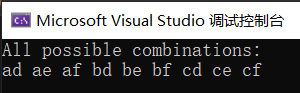
结果输出:
十、单词搜索问题
10.1、问题描述
给定一个二维网格和一个单词,找出该单词是否存在于网格中。单词必须按照字母顺序,通过相邻的单元格内的字母构成,其中“相邻”单元格是那些水平相邻或垂直相邻的单元格。同一个单元格内的字母不允许被重复使用。
10.2、解题思路
- 对于二维网格中的每个单元格,都可以作为单词的起始位置进行搜索。
- 编写一个递归的DFS函数,该函数接受以下参数:
- 当前单元格的坐标 (i, j)。
- 当前要匹配的单词中的字符索引 wordIndex。
- 在DFS函数内部,首先检查边界情况:
- 如果坐标 (i, j) 超出了网格范围,返回 false。
- 如果当前单元格的字符与要匹配的单词字符不相同,返回 false。
- 如果当前单元格的字符与要匹配的单词字符相同,将当前单元格标记为已访问,并递归地在上下左右四个方向搜索下一个字符。
- 在递归函数内,如果 wordIndex 达到了单词的长度,表示已经匹配成功,返回 true。
- 如果在上述搜索过程中没有找到匹配的路径,需要将当前单元格标记为未访问,并返回 false。
- 在主函数中,遍历二维网格的每个单元格,将其作为搜索的起始点,调用DFS函数进行搜索。如果有任何一个起始点返回 true,则表示单词存在于网格中。
10.3、代码示例
#include <iostream>
#include <vector>
#include <string>

using namespace std;

class Solution {
public:
    bool exist(vector<vector<char>>& board, string word) {
        rows = board.size();
        cols = board[0].size();

        for (int i = 0; i < rows; ++i) {
            for (int j = 0; j < cols; ++j) {
                if (dfs(board, i, j, 0, word)) {
                    return true;
                }
            }
        }

        return false;
    }

private:
    int rows;
    int cols;

    bool dfs(vector<vector<char>>& board, int i, int j, int wordIndex, string& word) {
        if (i < 0 || i >= rows || j < 0 || j >= cols || board[i][j] != word[wordIndex]) {
            return false;
        }

        if (wordIndex == word.length() - 1) {
            return true;
        }

        char temp = board[i][j];
        board[i][j] = ' '; // 标记为已访问,防止重复访问

        bool found = dfs(board, i + 1, j, wordIndex + 1, word) ||
                     dfs(board, i - 1, j, wordIndex + 1, word) ||
                     dfs(board, i, j + 1, wordIndex + 1, word) ||
                     dfs(board, i, j - 1, wordIndex + 1, word);

        board[i][j] = temp; // 恢复为未访问状态

        return found;
    }
};

int main() {
    Solution solution;
    vector<vector<char>> board = {
        {'A', 'B', 'C', 'E'},
        {'S', 'F', 'C', 'S'},
        {'A', 'D', 'E', 'E'}
    };
    string word = "ABCCED"; // 示例输入

    bool result = solution.exist(board, word);

    if (result) {
        cout << "The word exists in the board." << endl;
    } else {
        cout << "The word does not exist in the board." << endl;
    }

    return 0;
}
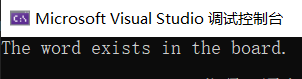
结果输出: